


Everything you need for Authorized Capital Increase
Authorized Capital Increase is the legal process of raising a company’s authorized share capital limit by amending its MOA and AOA and filing the required forms with the Registrar of Companies (ROC), allowing the company to issue more shares for business expansion, funding, or restructuring under the Companies Act, 2013.
Benefits of Authorized Capital Increase
- Allows company to issue additional shares,
- Supports business expansion and fundraising,
- Improves company valuation and growth potential,
- Enables induction of new investors or shareholders,
- Ensures compliance with Companies Act, 2013,
- Keeps capital structure flexible and future-ready
Eligibility Criteria for Authorized Capital Increase
- Company registered under the Companies Act, 2013,
- Authorized capital limit mentioned in MOA must be amendable,
- Board and shareholder approval required,
- Company’s statutory and annual compliances should be up to date
Company registered under the Companies Act, 2013
Authorized capital limit mentioned in MOA must be amendable
Board and shareholder approval required
Company’s statutory and annual compliances should be up to date
- Board Meeting – Approve proposal for capital increase,
- Shareholders’ Approval – Pass required resolution,
- Amend MOA & AOA – Update capital clause,
- ROC Filing – File SH-7 and MGT-14 (if applicable),
- ROC Verification – Scrutiny by Registrar,
- Approval & Update – Increased capital reflected on MCA portal
Why Choose Our Services?
- Expert handling of ROC and MCA procedures,
- Accurate drafting and timely filing,
- Affordable and transparent pricing,
- End-to-end compliance support,
- Fast processing and follow-up,
- Trusted by startups and companies across India
Get prepared
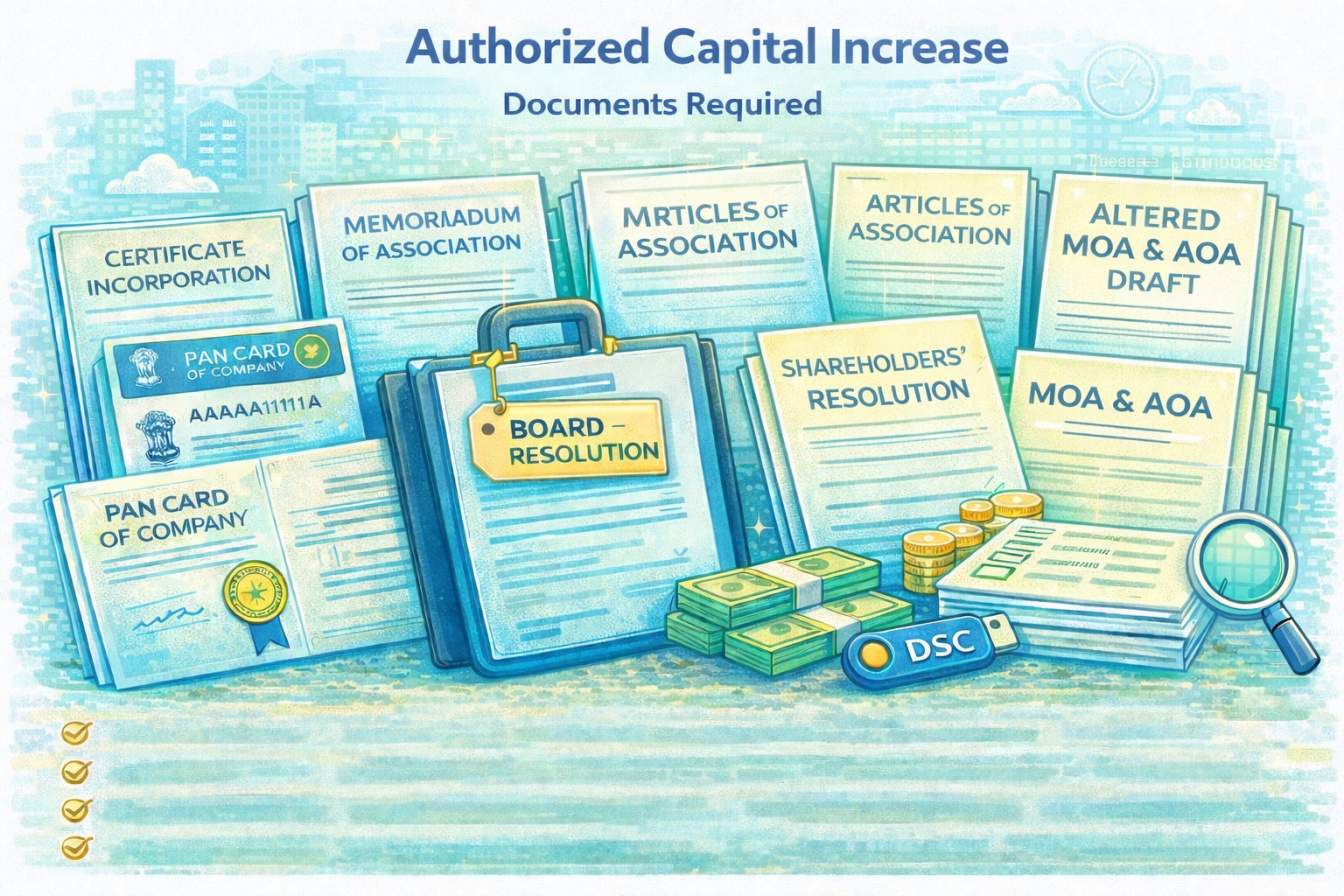
Documents & information required
- Certificate of Incorporation
- PAN Card of company
- Memorandum of Association (MOA)
- Articles of Association (AOA)
- Board resolution approving capital increase
- Shareholders’ special/ordinary resolution (as applicable)
- Altered MOA & AOA draft
- Digital Signature Certificate (DSC) of authorized director
- Previous ROC filing details